
“Hi Mr. Strader, This is Stewart from Fox 8, ya got a minute to talk to me?”
I hurtled down Highway 311, listening intently as the warm and informed voice on the cell phone filled in a few centuries of detail. After scratching out directions on notepad, I convinced the concerned viewer to let me meet him later at his place of employment. I hung up and squinted through the windshield at the TV tower in the distance. Yet another jaunt into the Great Unknown, I thought - a strange way to spend Memorial Day I‘ll grant you, but that’s quite simply the gig I got.
 A few minutes later Walker’s Mill road ended abruptly. I parked and unloaded, setting my tripod high on the roadside perch. Across the crumbling asphalt, a wide open expanse of rolling terrain stretched out toward a tree-ringed horizon. Sweeping the vista with my lens, I tried to decide where to start. I settled on a burbling creek to my right , honing in and pressing ’RECORD’. While the laser inside burned the water’s image on optical disc, I kicked at the clay and went over the details in my head. According to my new cell phone friend, this was the location of Bell’s Mill, site of a fabled act of loyalist defiance in the closing days of the Revolutionary War.
 Martha McFarland McGee Bell was the wife of a continental Captain William Bell, who owned Bell’s Mill, located near Muddy Creek in Randolph County. While Captain Bell was off fighting redcoats, Mary ran the Mill. In 1781, after the Battle of Guilford Courthouse, Lord Cornwallis himself rendezvoused with troops there for a two day rest. During their hostile bivouac, feisty Mary approached Cornwallis, and inquired as to whether he intended to burn her mill (as was his habit). Before he could answer, Mary proclaimed she would burn it first to deprive him the satisfaction! Quite ballsy for a woman in the 18th Century, but I suppose fierce patriotism knows no gender. Cornwallis left the mill unmolested that day. It stood for many more years before being lost to history. Only recently had it been uncovered, the hand-stacked stone wall remains unearthed by bulldozers clearing the way for the soon-to-be-formed Lake Randleman.
 Scrambling down the ditch bank with camera and tripod, I looked around for things to take a picture of. To my untrained eye, it was all rough terrain, hard-scrubbed land about to be submerged under fathoms of water. I’d covered the Randleman Dam before, knew that engineers were finishing construction on the mammoth wall upstream that would swell the Deep River and create a much-needed water-source for many Piedmont cities. I just never knew it was going to drown a little history in the process. That’s where Gary Strader came in. A Randolph County native with a penchant for history, he’d e-mailed the station with news of the old Mill’s plight. No doubt he’d be able to answer many of my questions when I met him later. For now though, I had a monument to meet.
 The heavy granite slab sat bathed in shadows of Guilford Courthouse National Military Park. Runners passing by just feet away would never see it. In fact several jogged by unknowingly as I hunched over my tripod and wrestled with a tricky focus. Slowly pushing the macro button across the breadth of the focal tube, I forced sharp edges on the wavering shapes in the viewfinder. ’HEROINE’ , it read. Bingo, I thought - just the kind of easily digested visual I needed for my story. When you’re condensing events spanning 250 years in ninety fleeting seconds, you needed all the compression you can get. After bagging a few more iconic shots, I dragged my gear over a low fence and captured footage of all the normal people enjoying their normal holiday off. Some walked family pooches, others jogged to the beat of their iPods. Kid and Grandmas ambled along and teenagers worked up a good hacky-sack sesh. Meanwhile, I loitered in the leafy shade, stalking statues and profiling pedestrians. While I could let that bother me, there’s no time for that now.
 Instead, I left the leafy sanctum of the manicured park for the growling exhaust fumes of the urban sprawl strip mall parking lot. At a large garage with a household name on the side of the wall, I found the service technician I was looking for. Gary Strader happily punched out and joined me in the parking lot. Using the only green backdrop I could find, I framed the stranger in front of a verdant slope of fresh cut grass, being careful to crop out the Chik-Fil-A sign in the upper right corner. As the tally light shone from the sanctity of the one inch screen, I found myself liking Mr. Strader as I listened. The self-avowed history buff knew his stuff, using five years of research to answer my series of inane questions.
 According to him, I’d been standing on top of the mill during my morning visit to the site. That didn’t make me feel any better about my skills of perception, but from the way he described the location in aching detail, I took his word for it. In the end, Strader was a television journalists’ delight - informed, authoritative, and mercifully succinct. He even coughed up a juicy detail to spice up my copy: Legend had it a band of loyalists buried a gold-filled cannon somewhere around the mill. If the area was flooded without proper excavation, the mythical treasure would disappear forever in a watery grave.
Overall, not bad fodder for an evening newscast feature OR a midnight bloggering, eh?


 Okay, so not EVERY assignment is an exercise in hustle and calamity. Some gigs are quite tranquil. Take the fifteen minutes I spent in a Guilford County strawberry field last week. Please! I don’t especially like strawberries. Sure, I ingest the occasional Wild Berry Pop-Tart, but I never enjoyed gnawing on this particular brand of nature’s candy. Still, I paused among the back rows of Ingram’s Strawberry Farm late that day, ignoring the screech of cell phone and pager just long enough to officially linger. Before I knew it, I was staring at a berry, lost in thought and enjoying the quiet.
 Four rows over a group of migrant workers chortled at the gringo at the edge of the field. When I first pulled up in my rolling billboard, the men among them came alive, gesturing happily at the familiar logo on the side of my ride. They probably hoped a leggy news model would hop out. Imagine their dismay when all they saw was this grumpy schlub, lugging gear and late for the edit bay. I waved from a distance and set up my sticks, wishing they‘d ignore my incongruent appearance. A few minutes later they went back to filling their white buckets with the plump red orbs. When they did, I fell into the viewfinder.
 I cut my broadcasting teeth on farm news coverage. Under the tutelage of the great John Spence, I prowled the sun-blotted tobacco field and the hazy shade of the selling floor. I’ve attended countless tractor shows, documented festive hog killings and profiled plucky poultry producers. If it grows in the Tar Heel State, I’ve pointed a lens at it. Along the way, I’ve many an ornery farmer - from leathery landsmen in Depression-era coveralls to their younger men who cannot imagine farming without their laptops and Chevy Silverados. I like both kind, as there’s rarely a trace of subterfuge or fakery among them - qualities I get more than my share of with this thing on my shoulder.
 A long Spanish soliloquy awoke me from my daydream. Whatever the younger man said amused his cohorts; even the old ladies laughed as thewy stooped over to fill their buckets. I chuckled too, at the absurdity of it all. A high-winding motor wailed in the distance. Shaking off any idling thoughts, I got busy collecting assorted angles of said berries, more than enough to supply the forty seconds of edited video the desk wanted. As I gathered up my tools and prepared to leave, a young man rolled up on a 4 wheeler and began chattering with the workers. I was halfway through packing up my car when I realized they were answering him in perfect English.
 I began my shift with a quick jaunt to Mayodan, one of many Rockingham County towns crippled by the loss of the textile industry. As I toured the weed-choked grounds of yet another manufacturing cadaver, I couldn’t help but think of the recently razed Burlington Industries building. But this case is a little different. Shut down in 1999, the old Washington Mill sits on the Mayo River - a winding waterway that the leaders of Greensboro would kill to have in THEIR downtown. But Mayodan’s river walk is overrun with neglect - as is the cavernous mill that many say started the town in the first place.
 Now a group of local developers wants to transform the Mill’s rotting carcass into a glitzy showcase. Their 35 million dollar proposal is impressive: a theater, condos, restaurants, banquet halls, spas and more - all built into the sprawling brick structure that anchors downtown. At the center of their plans, the piece de resistance: a North Carolina Gospel Music Hall of Honor. I don’t know a lot about gospel music, but if such a place would help bring this part of Rockingham County back to life, well - somebody pass me a tambourine. Dennis Sparks, one of the developers, showed me around the old mill, answering my questions and carrying my tripod. He didn’t even flinch when I handed my digital camera to his assistant and asked her to take a picture. Nice guy, that Mr. Sparks.
 After an hour and a half on site, I had what I needed to file my report. But I couldn’t just stick my raw footage on air and go get a sandwich. No, my raw material requires intense examination, thoughtful contemplation, and one heck of an edit session before it can invade living rooms around the Piedmont. This I bid Mr. Sparks and company a fond adieu and made a beeline to High Point. I’d like to tell you I thought about my assigned story al the way back to the station, but in reality I jammed out to William Shatner’s incredible CD, ‘
 Once back at the shop, I found every one of our tricked-out edit bays filled with swarthy photogs, antsy reporters and over-dressed interns. Knowing better than to cross this hostile crowd, I grabbed my camera and my headphones and plopped down at my desk. Sitting there, I rifled through the footage on my disc, transcribing sound-bites, making notes and trying to ignore the producers who were challenging each other’s movie trivia knowledge from opposite sides of the newsroom. Forget exhausting shoots and unforgiving deadlines, the hardest part of my day is staying focused on my story at hand while the night-siders play grab-ass all around me. The headphones help. Perhaps I should have brought in my
 In the third act of my day, I move to the edit bay. Once fully hunkered, I create a timeline on the non-linear editor and begin ingesting footage into a virtual bin. With a click and a drag, I can access the audio narration - words I wrote only minutes before handing the script over to an anchor to voice. Once those dulcet tones are fully loaded, I use them to frame up my ninety second sound structure. Of course there is the inevitable audio tweaking, understandable, since audio is the very lifeblood of all broadcasting. After slicing and dicing anchor track and sound-bites, I had a NPR-worthy aural masterpiece. But this ain’t radio. Scrolling through my footage, I searched for just the right shot to back up each spoken moment. If I’ve done my job right, it all falls together like per-cut pieces to a perfect puzzle.
 I love to edit - and not just because it involves sitting down. Sometimes it’s like conducting the world’s most perfect orchestra. Other times, it’s like crash-landing a wounded helicopter. Either way, each edit session is a lesson in good and bad decisions in the field. With the advent of computer editing, a whole new realm of visual storytelling is at hand. Difficult effects that used to require bribing the control room gang down the hall is now just a click or two away. I’m far less articulate than other editors in my shop. Friends of mine can recite 17 level edit-moves backwards and forwards and their work shows it. But me - I’m more of a Zen Master than dry technician. I feel the focus should be on storytelling, not technique. Of course that doesn’t stop me from screaming for for a Edit-Master’s council when the need arises.

 So it shouldn’t have surprised me when he clung to the idea, quickly turning it into the latest installment of
 I’ll take that, as I am a great lover of books. Here’s just one of my many shelves now, stacked to the rafters with tomes, accounts and chronicles. Tattered copies of science-fiction classics and lurid paperback novels rescued me from a childhood filled with playmates who only wanted to ‘play ball‘. With adolescence came Stephen King. For years I counted my hardbacks of ‘
 With Monday’s
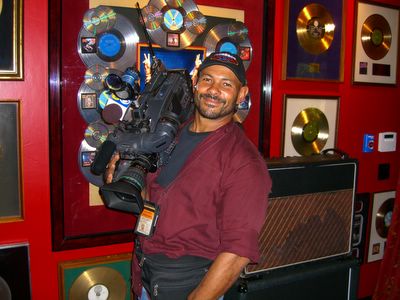
 From Tripod Row, the view’s indeed a little scary. Squinting civilians peering into tiny lenses, breaking bedrock principles of camera-handling with every unnecessary sweep and pan. No one expected the democratization of media to be pretty, but the attendant lens abuse is enough to break this cinematographer’s heart. But that ship has sailed, a nautical phrase as apparently outdated as Wide-Medium-Tight and Steady Sequenced Video. What use are lofty production values to the herky-jerky nature of today’s internet footage? Does proper composition really matter when the end product is viewed on a one inch screen? Of course it does - but only to us broadcast dinosaurs. This new hybrid breed of digital scribe gives little thought to such matters, instead relying on quick image uploads and push-button publishing to make up for his lack of camera acumen.
 It’s enough to make those of us in the media scrum to talk of the End Times. Years of shoulder mounted betacam security are grinding to an unceremonious halt and crashing onto the shores of shrinking technology. With phone companies morphing into video portals and infidel consultants preaching the power of the One-Man-Band, it is simply not a good time to be a TV news photographer. One hasn’t got to look far into the cameraman’s past to recognize a similar shift. In the early Eighties, videotape quickly surpassed film as Television’s medium of choice. Suddenly journeyman photogs found their hard-earned tenure as film-processing auteur simply didn’t matter. Videotape was cheap, instantaneous, and far easier to use. Though the gear was bulky, there were plenty of underpaid young upstarts willing to take up the new dumb-downed format. As they did, thousands of veteran film crews laid down their lenses and for a long while afterwards, the evening newscast suffered.
 Now, a new revolution is about to be televised. Tiny lenses are popping in the most unlikely of devices, powerful editing is just a laptop away and personal websites are racing towards critical mass. How long before my oversized fancy-cam looks like an early 80’s bag phone? About the same time the six o clock news begins looking like it was shot by a hopped-up junkie with a twitchy digital, I‘m guessing. The next ten years promise to feature a rapid breakdown of my chosen craft. Whatever new paradigm takes hold, it’s a safe bet the two-person news crew is an endangered species, driven to oblivion by technology and methods that are faster and cheaper, but not necessarily better. Hopefully by that time, I’ll have found more fulfilling ways to make a difference and a paycheck. Until then, I’ll be here in the media pack, one eye buried in a viewfinder, the other one keeping steady watch over a nation of digital interlopers. Now tell the accountant with the handy-cam to get the #&%% out of my shot...